


Working Papers

Descriptive Summary:

Morocco–Netherlands Migration Skill Corridor: Echoes on the Highway

This working paper examines the Morocco–Netherlands corridor as a post–guest worker migration pathway with deep historical roots but limited contemporary skilled mobility. 

Based on 27 stakeholder interviews and policy analysis, the paper finds that while a formal mobility partnership and bilateral agreements exist, cooperation is politically sensitive and primarily framed around return and readmission. Skilled migration remains marginal, and the corridor appears to be phasing out as Moroccans increasingly choose alternative destinations and second-generation Dutch-Moroccans explore return. Mobility is driven more by social networks and community dynamics than by structured recruitment initiatives. Existing initiatives for academic exchange and pilot circular migration schemes remain small in scale. 

The paper concludes that the corridor represents an underutilised opportunity: unlocking its potential would require reframing the political narrative, strengthening private-sector engagement, and developing a more holistic, skills-oriented partnership.
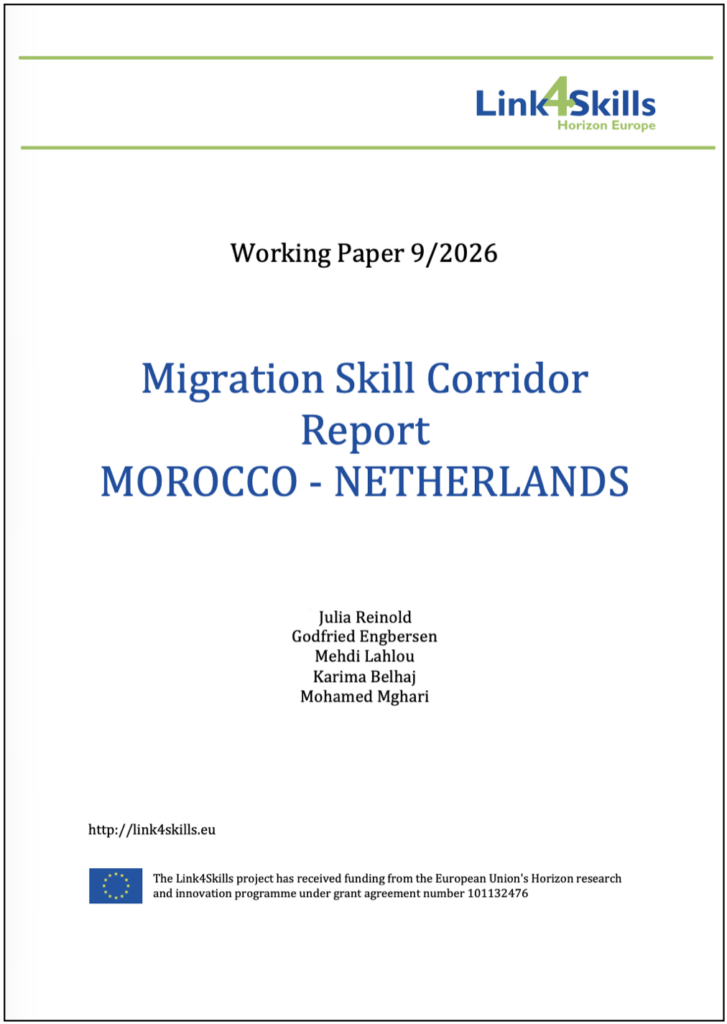

Descriptive Summary:

Morocco–Netherlands Migration Skill Corridor: Echoes on the Highway

This working paper examines the Morocco–Netherlands corridor as a post–guest worker migration pathway with deep historical roots but limited contemporary skilled mobility. 

Based on 27 stakeholder interviews and policy analysis, the paper finds that while a formal mobility partnership and bilateral agreements exist, cooperation is politically sensitive and primarily framed around return and readmission. Skilled migration remains marginal, and the corridor appears to be phasing out as Moroccans increasingly choose alternative destinations and second-generation Dutch-Moroccans explore return. Mobility is driven more by social networks and community dynamics than by structured recruitment initiatives. Existing initiatives for academic exchange and pilot circular migration schemes remain small in scale. 

The paper concludes that the corridor represents an underutilised opportunity: unlocking its potential would require reframing the political narrative, strengthening private-sector engagement, and developing a more holistic, skills-oriented partnership.