
Migration Skill Corridor Briefs

The India-Germany migration skill corridor – predominantly shaped as a highly skilled corridor – has recently shifted focus increasingly towards sector-/occupation-specific type, structured through long-term skills mobility partnerships with strong private involvement. Driven by labour shortages and supported through extensive bilateral cooperation, the corridor has expanded beyond traditional high-skilled migration in STEM fields to a rise in student migration and growing recruitment in healthcare, technical, and industry fields (emerging). Access to language training, recognition issues, expectation mismatch, and weak regulation of private actors shape the migration flow outcome of the corridor’s scale and quality.
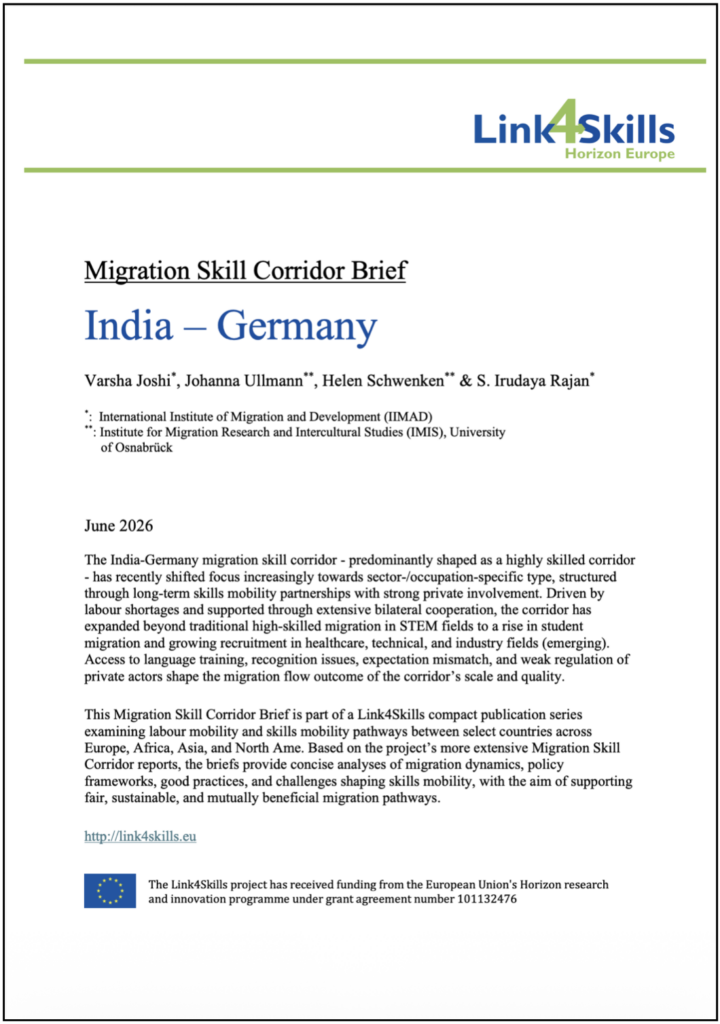



The India-Germany migration skill corridor – predominantly shaped as a highly skilled corridor – has recently shifted focus increasingly towards sector-/occupation-specific type, structured through long-term skills mobility partnerships with strong private involvement. Driven by labour shortages and supported through extensive bilateral cooperation, the corridor has expanded beyond traditional high-skilled migration in STEM fields to a rise in student migration and growing recruitment in healthcare, technical, and industry fields (emerging). Access to language training, recognition issues, expectation mismatch, and weak regulation of private actors shape the migration flow outcome of the corridor’s scale and quality.

 

Â